
- Specialities
- Laparoscopy
- Urology
- Gynaecology
- Proctology
- Aesthetics
- Vascular
 080-6541-7872
Umbilical-hernia Treatment in Vagamon
Treatment & Care
Advanced umbilical hernia treatment in vagamon with minimally invasive methods ensures quick recovery and enduring relief.

 Call Us: 080-6541-7872
Advanced Umbilical Hernia Treatment in vagamon with high success rates.
In vagamon, umbilical hernia, where tissue protrudes through a weak area near the navel, is treated with cutting-edge, minimally invasive methods. Expert surgeons provide personalized care, often utilizing laparoscopic techniques for quicker recovery. Early detection and prompt surgical treatment are crucial for minimizing complications and enhancing life quality.
Cautionary Indicators
Identify early umbilical hernia symptoms for prompt medical evaluation

Prominent Bulge
Gentle lump close to the belly button

Stomach Discomfort
Aching sensation near the navel area

Queasiness
Unexpected nausea or vomiting episodes

Tissue Enlargement
Growing swelling near the belly button

Skin Tone Change
Red or dark hue over the protrusion

Persistent Bulge
Lump remains firm when reclining


Warning Signs of Severe Umbilical Hernia
Seek Emergency Care Immediately if:
Seek Emergency Care Immediately if:
 Intense discomfort near the belly button region Hernia hardens and cannot be pushed back Nausea, vomiting, and changes in bulge size Red or darkened skin over the hernia site Fever accompanied by abrupt navel swelling
- Intense discomfort near the belly button region
- Hernia hardens and cannot be pushed back
- Nausea, vomiting, and changes in bulge size
- Red or darkened skin over the hernia site
- Fever accompanied by abrupt navel swelling
Meet Our Best Umbilical Hernia Specialists

Dr. Dhamodhara Kumar C.B
MBBS, DNB-General Surgery
 Free Consultation
 27 Years Experience
 Kochi, Ernakulam, Kerala 682025
Dr. Sunil Joseph
MBBS, MS, MMIP (Proctology)
Free Consultation 18 Years Experience Kochi, Ernakulam, Kerala 682025
Dr. Nidhin Skariah
MBBS, MS
Free Consultation 15 Years Experience Edappally, Kochi, Kerala 682024 MEDICAL INSIGHT
Factors leading to the development of umbilical hernia.
A weak area near the navel allows abdominal tissue to protrude, causing umbilical hernias. Contributing factors are obesity, multiple pregnancies, and ongoing abdominal strain. In infants, these hernias frequently arise from the incomplete closure of abdominal muscles post-birth.
 Weakness in abdomen
 Excess body weight
 Frequent pregnancies
 Lifting heavy objects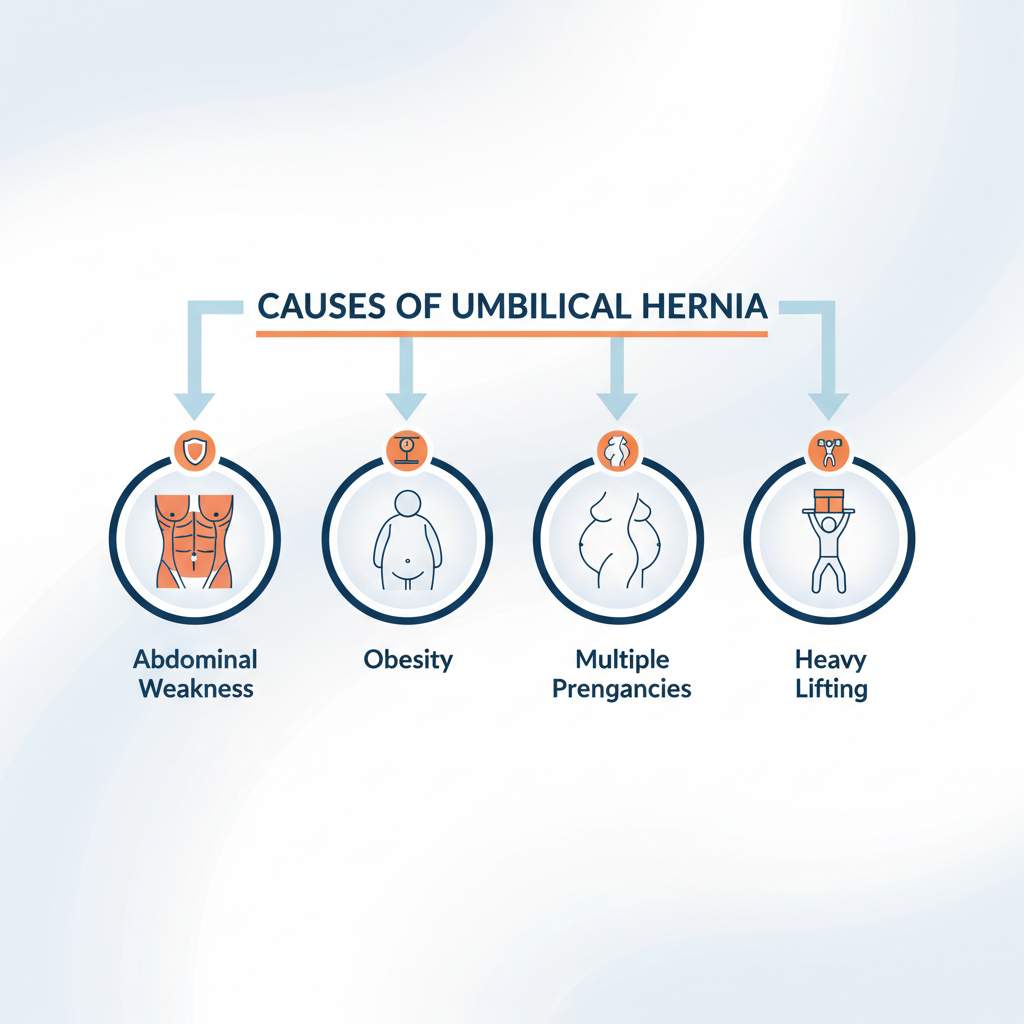
Ready to get the right care?
At-Risk Individuals?
Specific health and lifestyle factors increase the likelihood of umbilical hernias in certain people.

Newborns and infants are prone to umbilical hernia.
Higher risk of umbilical hernia in premature or low-birth-weight infants.

Umbilical hernia is common in pregnant women.
Increased abdominal pressure from multiple pregnancies raises hernia risk.

Obese individuals face higher hernia risk.
Excess weight strains the abdominal wall, increasing hernia likelihood.

Patients with chronic cough are at risk.
Persistent coughing raises intra-abdominal pressure, leading to hernias.

The Critical Phase
If sudden pain, vomiting, or a firm, discolored hernia bulge occurs, seek immediate medical care.
ALWAYS HOSPITALIZE HIGH-RISK PATIENTS
Potential issues
Serious health risks may arise from untreated umbilical hernias, necessitating urgent medical care.

Tissue entrapment
Severe pain and swelling occur when bowel tissue is trapped in the hernia sac, causing digestive obstruction.

Tissue death risk
Emergency surgery is needed when blood supply to herniated tissue is blocked, risking tissue death.

Potential infection
Prompt treatment is crucial to avoid serious abdominal infections from strangulated or ruptured hernias.

 Nearest Clinic
Therapy & Healing
Advanced surgical methods and recovery advice for umbilical hernia

Operative Fixation
Faster recovery often seen with minimally invasive methods.

Minimally Invasive
Laparoscopic repair minimizes tissue damage and hospital time.

Recovery After Surgery
Routine activities usually resumed by patients within days.


Advanced In-Patient Care
Our surgical team employs cutting-edge, minimally invasive mesh repair methods with high success rates and thorough post-operative care.
 CRITICAL ALERT
Get prompt medical attention for sudden pain, vomiting, or hernia color change.
 Avoid heavy lift
 Avoid ibuprofen
 Avoid straining
Consult a professional before any medication.
Urgent intervention needed for umbilical hernia issues.
If your umbilical hernia exhibits strangulation or obstruction, seek emergency medical care promptly.
 Emergency Hotline


Preventing umbilical hernia: Your best defense against it.
Adopting simple lifestyle habits can lower the risk of umbilical hernia.

Keep a healthy weight.
Carrying extra weight can increase the risk of umbilical hernia.

Lift with care.
Use proper lifting techniques to protect your abdomen.

Address chronic cough.
Get medical help for persistent coughing to lower hernia risk.

Avoid constipation.
Eat a high-fibre diet to ease bowel movements and prevent strain.


Your health is our
sole priority.
Need Expert Medical Consultation?
Our network of Umbilical Hernia specialists are available for immediate clinical evaluation and personalized recovery planning.

Frequently Asked Questions
Surgical repair, either open or laparoscopic, is used to treat umbilical hernias. Minimally invasive methods provide smaller incisions, less discomfort, and quicker recovery for most patients.
Surgery isn't always necessary. Small hernias may be observed, but if they grow, cause pain, or pose risks, surgery is advised. A specialist will determine the optimal approach.
 Call Us
 Book Appointment


